cTILI Score
Thrombectomy in
Acute-on-Chronic Limb Ischemia Score

The Thrombectomy in Acute-on-Chronic Limb Ischemia (cTILI) Score is a proposed angiographic grading system designed to classify the technical success of revascularization procedures in acute-on-chronic limb ischemia. It represents a further development of the original TILI Score, which was designed for embolic acute limb ischemia in limbs without pre-existing atherosclerotic disease.
The cTILI Score accounts for the specific challenges of acute-on-chronic limb ischemia by evaluating procedural success in relation to the pre-interventional angiographic status, rather than as an isolated post-procedural finding.
Lesion Recanalisation Grade 0-3
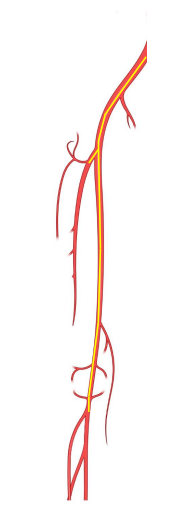
Perfusion in the primary ocluded main vessel and all subsequent main arteries from common iliac artery until the distal popliteal artery with main trunc of the deep femoral artery
Perfusion grade will be evaluated analogously to the TILI Score:
•Grade 3: Full perfusion or less than 10% vessel narrowing (independent of whether stenting was performed).
•Grade 2: Antegrade, fast flow with residual vessel narrowing between 10% and 50%. Flow through the lesion is faster than the one of collaterals.
•Grade 1: More than 50% vessel narrowing with slow antegrade flow; collateral vessels fill faster than the treated segment.
•Grade 0: No antegrade flow through the lesion, with distal perfusion occurring only via collateral circulation. No crural perfusion.
Crural Vessels Patency
•Crural vessel patency will be assigned an a/b/c score corresponding to one, two, or three open crural vessels at the end of the intervention
•Crural vessel is considered open if it has antegrade flow up to the midfoot* (with less than 50% stenosis occurring along its length) fast
flow / sufficient flow to the midfoot
•In contrast to the original TILI Score, the peroneal artery is considered equally important as the tibial arteries. Therefore, if only the fibular artery is patent it earns the score a
•To score a crural artery as patent, its pedal extension must remain at least the same as it was before the intervention.

* Or, at least, the hindfoot, assuming it has developed a network of pedal collaterals.
Hindfoot begins at the ankle joint and ends at the transverse tarsal joint, incorporating the calcaneus and talus bones
Midfoot—Begins at the transverse tarsal joint and extends to the tarsometatarsal joint, incorporating the navicular, cuboid, and cuneiform bones.
Post-Interventional Crural Vessel Scoring
After the intervention, any change in the number of patent crural vessels will be indicated in parentheses following the final grading (e.g., +1 or –1). This notation reflects whether peripheral embolisation occurred or whether any crural artery was successfully reopened.
Preinterventionell a crural vessel is considered open if it has a pedal extention and at least 50 % of ist distal length is visualised in the angiography.

Example
Before
After
This patient presented with acute occlusion of the popliteal artery. In the initial angiogram, no crural vessel was patent with direct perfusion of the foot.
After revascularization, the flow in the popliteal artery was fast and achieved grade 3. There was only one crural vessel patent reaching the midfoot via collaterals — the anterior tibial artery. The posterior tibial artery reached only the ankle and had no significant impact on foot perfusion.
The score is 3a (+1)
Interessted?
Are you interested in the further development of the cTILI and TILI Scores?
We are planning a worldwide validation of the score, as well as additional studies using these scores as study endpoints.
Please contact us with your feedback or interest in collaboration using the form below.